SCENARIO 05·R&D·Knowledge Q&A
The Same Standards Question Requires Another Document Search or Interruption to Senior Staff
When a specification question arises, R&D searches standards, customer specifications, and past issue records for an answer. If employees cannot find or understand the answer, they ask senior staff.
The person asking must wait for a reply, while the person answering is interrupted. Another employee may later ask the same question again. Troubleshooting has the same problem. Previous solutions often remain only in the employee's memory or are scattered across emails and meeting records, making them difficult for new employees to find.
At a glance
How it was done
- Search standards in the shared folder
- Ask senior staff if no answer is found
- Give a verbal answer without a source
- Use after engineer confirmation
Where it gets stuck
The person asking must wait for a reply, while the person answering is interrupted. Another employee may ask the same question again. The answer has no source, making it difficult to confirm whether it uses the latest version.
With an AI Agent
- Search standards in the shared folder
- Ask senior staff if no answer is found
- Give a verbal answer without a source
- Use after engineer confirmationHuman approval
The AI Agent searches standards, organizes answers, and cites sources. If it finds no supporting source, it says so directly. The responsible engineer still confirms any conclusion that affects design or quality decisions before it is used.
How it was done
- 01When a specification or quality issue arises, first search the shared folder for relevant standards
- 02If the answer cannot be found or understood, ask senior staff
- 03Senior staff search documents or answer from experience
- 04The answer is given verbally without a source, so the same question is asked again next time
- No.
- EX-ENG-STD-012 Revision C
- Date
- Effective 2026-07-01
| Thread | Grade 8.8 | Grade 10.9 |
|---|---|---|
| M6 | 10 | 14 |
| !M8 | 25 | 35 |
| M10 | 49 | 69 |
| M12 | 85 | 120 |
| Clause | Content |
|---|---|
| Section 2 | For thread sizes not listed, follow the project drawing. Do not interpolate or extrapolate values. |
| Section 3.1 | For carbon steel bolts threaded into aluminum holes, the tightening torque is 70% of the value in the table above |
| !Revision C | The value for M8 grade 10.9 was revised from 32 N·m to 35 N·m |
With an AI Agent
- 01What it doesSearch the knowledge base for standardsStandard appliedAnswer only from standards in the knowledge base and use the currently effective revisionOutputThe relevant standards section for each question
- 02What it doesOrganize answers and cite sourcesStandard appliedFor each question, provide the document number, revision, and section or table. Show the calculation when required, such as applying 70% of the torque for aluminum.OutputAn answer table with the question, answer, and source
- 03What it doesReport when no supporting source is foundStandard appliedFor questions not covered by the standards, respond directly that no supporting source was found and explain the limits of the standards. Do not answer from general engineering knowledge.OutputQuestions without supporting sources and explanations
- 04What it doesFlag questions that require an engineer's decisionStandard appliedIf a question asks to change a standard requirement or relax a condition for a customer, only state what the standard requires and mark it as "Engineer confirmation required"OutputUse the conclusion only after engineer confirmation
- Human approval
- Step 4 remains with the responsible engineer. The AI Agent finds sources and organizes the answer, but an engineer must confirm any conclusion that affects a design change or quality decision before it is used.
- Platform modules used
- Knowledge base
For knowledge Q&A tasks, we recommend that every document include a version, date, and source, and that every answer cite the original location. The department must also assign someone to update documents and remove expired information. A large knowledge base does not guarantee success. Version control, validity periods, and maintenance processes determine whether answers can be trusted.
Screenshots show the Traditional Chinese interface.
01Add Standards to the Knowledge Base
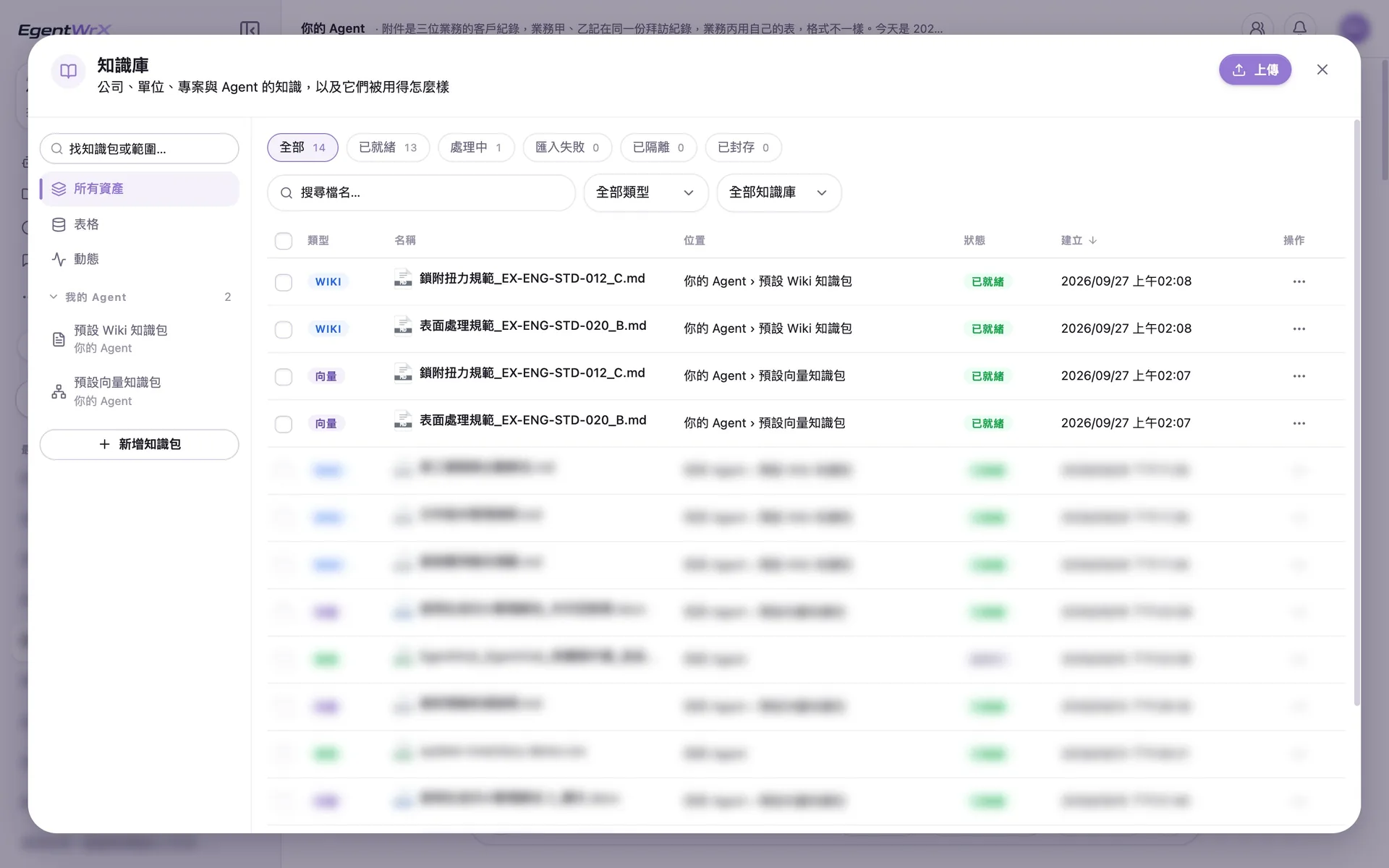
- 1Add the Bolt Tightening Torque Standard and Surface Treatment Standard to the knowledge base.
- 2Start asking questions only after both documents show "Ready."
02Upload the Question List and Instructions
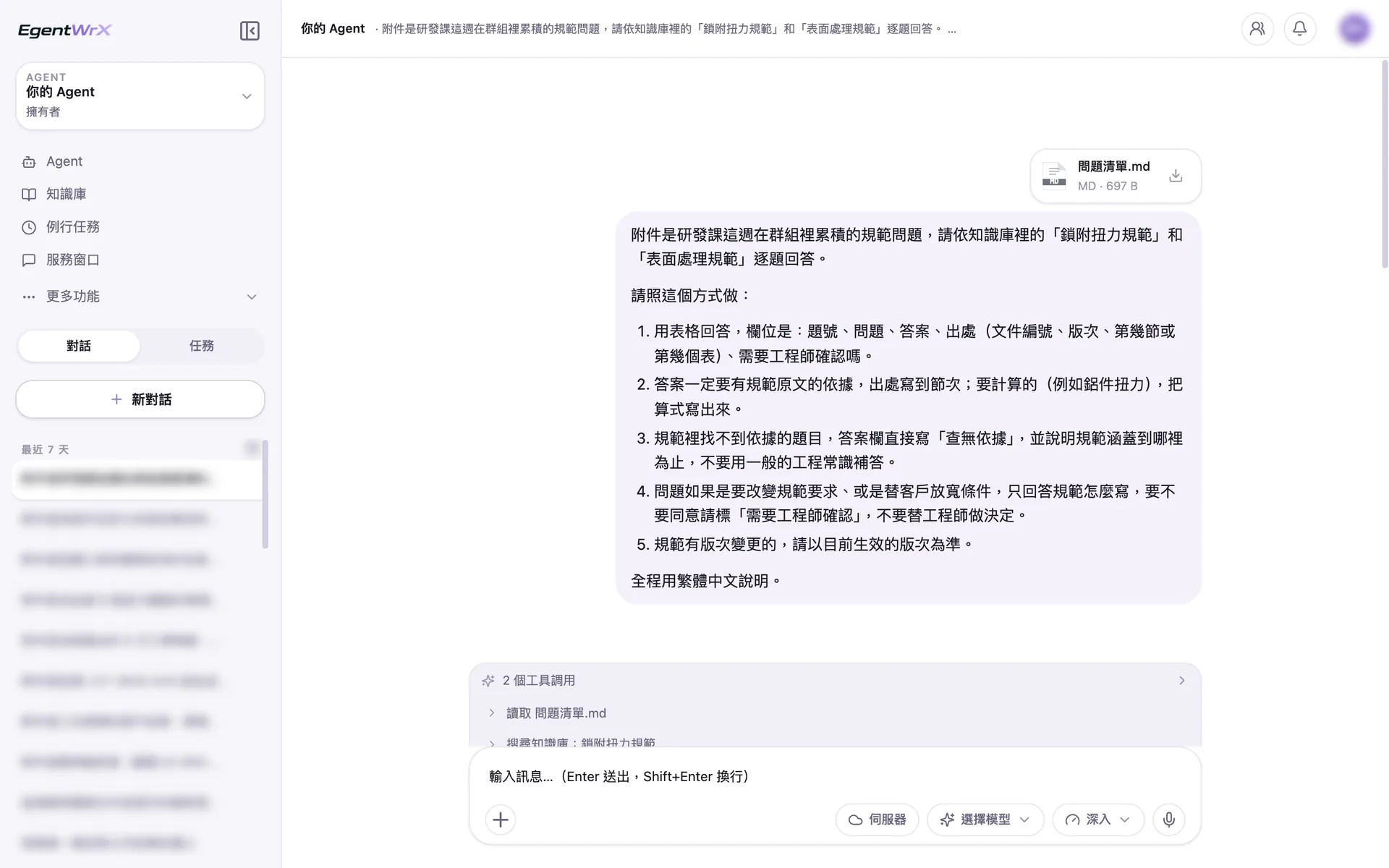
- 1Upload the employees' accumulated question list as an attachment.
- 2If no supporting source is found, state "No supporting source found" instead of answering from general engineering knowledge.
- 3For requests to relax a standard, only state what the standard requires and leave the decision to an engineer.
03Execution Process
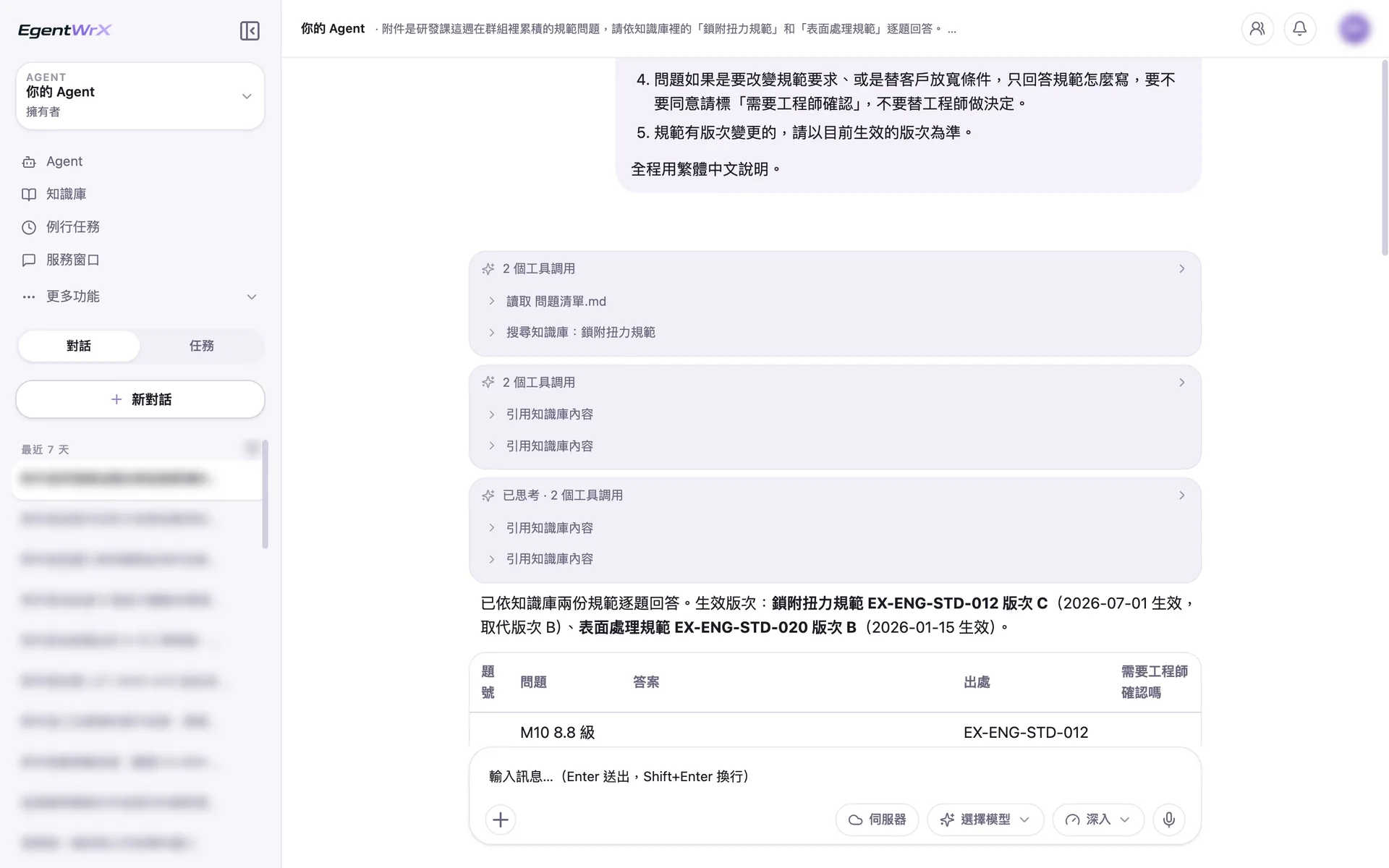
- 1Search the knowledge base for the Bolt Tightening Torque Standard.
- 2Cite the original standard text from the knowledge base for each question.
- 3First confirm the currently effective revisions of both standards.
04Answer Table
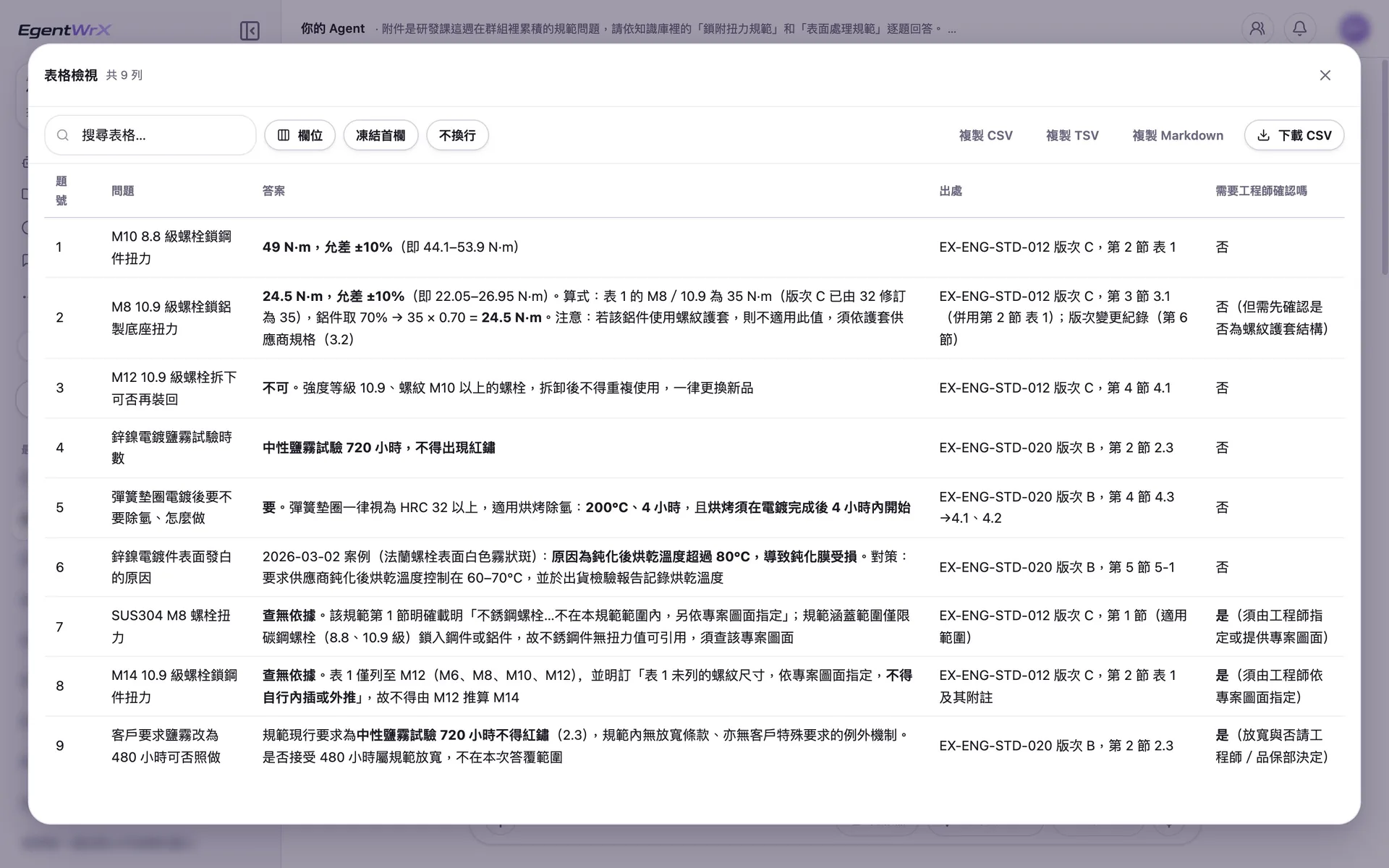
- 1Show the aluminum torque calculation using the latest value of 35 N·m.
- 2Cite the document number, revision, and section.
- 3For the stainless steel bolt and M14 questions not covered by the standards, respond "No supporting source found."
- 4Mark the customer's request to relax the requirement as requiring engineer confirmation.
Numbers
Standards lookup saves an estimated 4 to 12 hours per month, and issue troubleshooting saves 0.5 to 1.5 hours per month
Source: An unnamed automotive parts manufacturer advised by Intellicon Solutions
FAQ
- Will the AI Agent make up an answer if the knowledge base does not contain one?
- No. This process is designed to report that no supporting source was found when it cannot find the original source. It does not answer from the language model's general knowledge. In our client projects, fluent answers without sources are the most common cause of failure in knowledge Q&A.
- How do you prevent searches from returning an old standard when both old and new versions exist?
- Each document is labeled with its version and validity period when it is added to the knowledge base. The department owner removes expired versions. Keeping old and new standards together without validity periods is one of the most common problems in these tasks. Each answer also includes the version so employees can verify it.
- Should we add all documents at once?
- We do not recommend it. Adding a large batch of unorganized files to the knowledge base makes accurate answers more difficult. A more reliable approach is to start with the standards and issue records that employees ask about most often, organize their versions and sources, and then expand gradually.
Where to go next
Want every employee to have their own AI teammate?
A consultant will be in touch shortly.