SCENARIO 20·HR·Responsibility Inventory
Ask Employees "What Do You Want AI to Do?" and Most Responses Are Blank or Just Say "Improve Efficiency"
The first step in AI implementation is often to send out a needs assessment form and ask each department what it wants AI to do. However, employees must first understand what AI can do. This is difficult for people who have not used AI.
Management wants to know where to deploy AI first and how much time it can save. However, HR and the implementation team only receive responses such as "purchasing management" and "quality management," which do not provide enough information to set priorities.
At a glance
How it was done
- Send a form asking "What should AI do?"
- Receive job function names or blanks
- Start with tasks that appear likely to deliver the fastest results
- Managers select the first tasks
Where it gets stuck
Most responses are job function names such as "purchasing management." The team cannot set priorities, so it starts with tasks that are easiest to measure. Responsibilities that consume the most work hours are not identified.
With an AI Agent
- Send a form asking "What should AI do?"
- Receive job function names or blanks
- Start with tasks that appear likely to deliver the fastest results
- Managers select the first tasksHuman approval
Ask employees what they do in their regular work, calculate monthly work hours, and use the TURBO criteria to flag responsibilities suitable for AI Agent. Department managers and the implementation team decide which tasks to start with and which should not be assigned to AI.
How it was done
- 01Send out a needs assessment form and ask each department what it wants AI to help with
- 02Most responses are job function names or general expectations
- 03The implementation team can only start with tasks that are easiest to measure and appear most likely to deliver quick results
- 04Responsibilities that consume the most work hours are not identified
| Example Machinery: AI Implementation Needs Survey Response Summary | |
| Survey Question: Describe what you want AI to help you do | |
| Department | What should AI help with? |
| Purchasing | Purchasing management |
| Purchasing | Responding to suppliers |
| Quality Assurance | Quality management |
| Finance | Help me review invoices |
| Sales | Automatically respond to price inquiries |
| Administration | Compile weekly reports |
| Production | (blank) |
With an AI Agent
- 01What it doesCalculate monthly work hoursStandard appliedMonthly frequency × time per task × number of users; count daily as 22 times, weekly as 4 times, monthly as 1 time, and quarterly as 1/3 time. Convert durations not stated in minutes and flag themOutputMonthly work hours for each responsibility
- 02What it doesFlag using the TURBO criteriaStandard appliedEvaluate one item for each of the five criteria: time required meets the company's defined threshold (T), enough users perform the task (U), the task occurs at least once per week (R), someone can review it (B), and the steps are clear and easy to break down (O). List the letters for the criteria metOutputResponsibilities ranked by the number of criteria met
- 03What it doesList data that needs correctionStandard appliedIf an entry only names a job function, does not show its inputs and outputs, or omits the frequency or time required, do not calculate its work hours or rank it. Add it to the correction list. If two people enter the same content, calculate both entries as usual and flag them as possible duplicates. Do not rewrite or merge themOutputCorrection list and department totals
- 04What it doesSend to department managers and the implementation teamStandard appliedReview department totals only. Do not rank employees or compare individuals. Remind department managers and the implementation team to review implementation progress together. They decide which responsibilities to handle firstOutputDepartment managers and the implementation team select the first tasks
- Human approval
- Department managers and the implementation team select the first tasks. They decide which responsibilities to handle first and which should not be assigned to AI. AI Agent organizes and initially flags the items but does not set priorities for people.
- Platform modules used
- Skills
We recommend describing each responsibility as an action with identifiable inputs and outputs, rather than listing only a job function. Initially, prioritize tasks with clear rules, consistent inputs and outputs, and visible errors. TURBO provides five criteria for selecting the first tasks: time required, number of users, high frequency, availability of a reviewer, and ease of breaking down the process.
Screenshots show the Traditional Chinese interface.
01Upload the Responsibility Inventory and Instructions
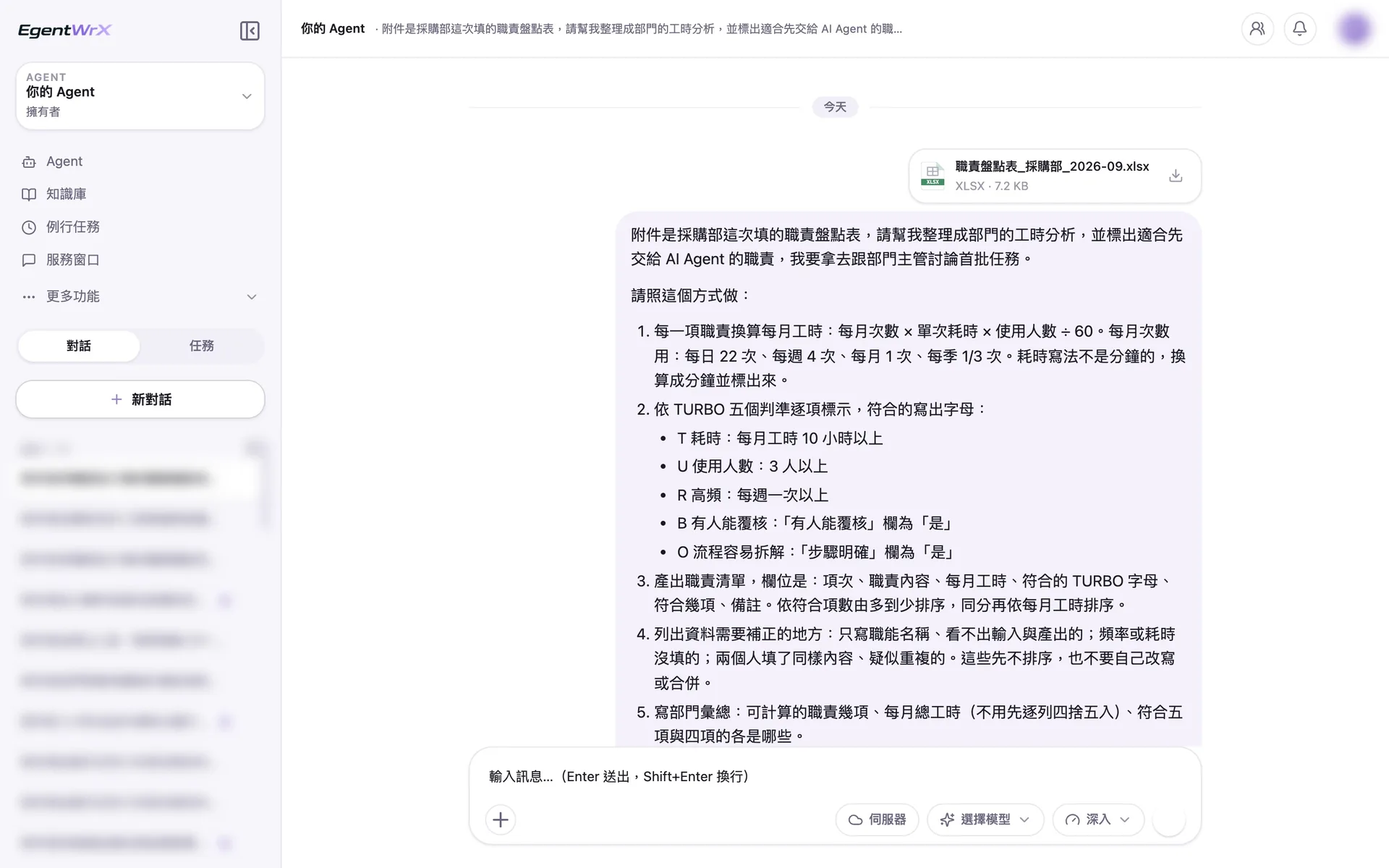
- 1Upload the Purchasing Department's responsibility inventory.
- 2The instructions define how to calculate monthly work hours.
- 3Each of the five TURBO criteria has a specific threshold.
- 4Do not rank, rewrite, or merge data that requires correction.
02Execution Process
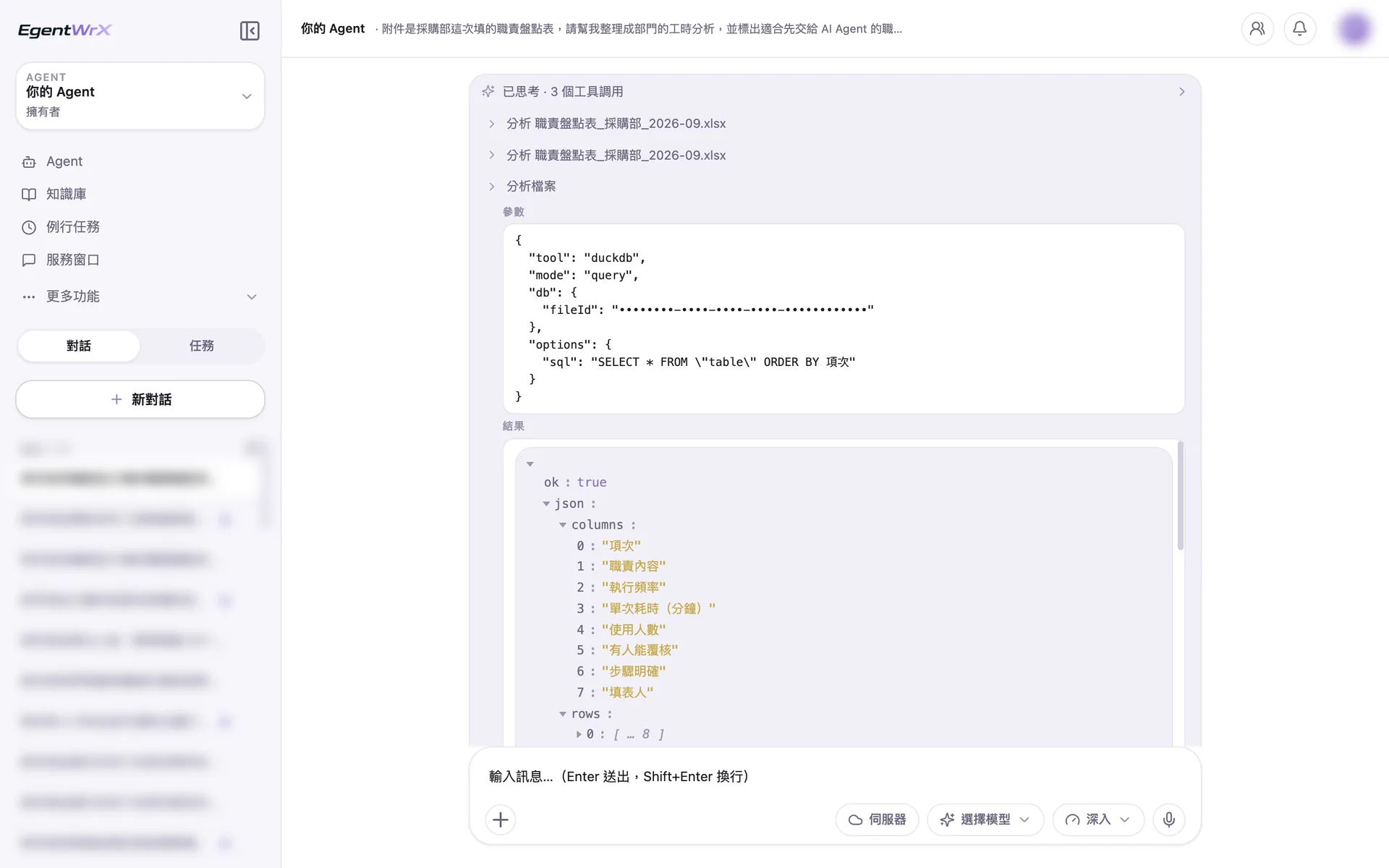
- 1Read the inventory in 3 steps.
- 2Read the entire inventory item by item.
- 3Fields include responsibility, frequency, time required, number of users, availability of a reviewer, and whether the steps are clear.
03Responsibility List
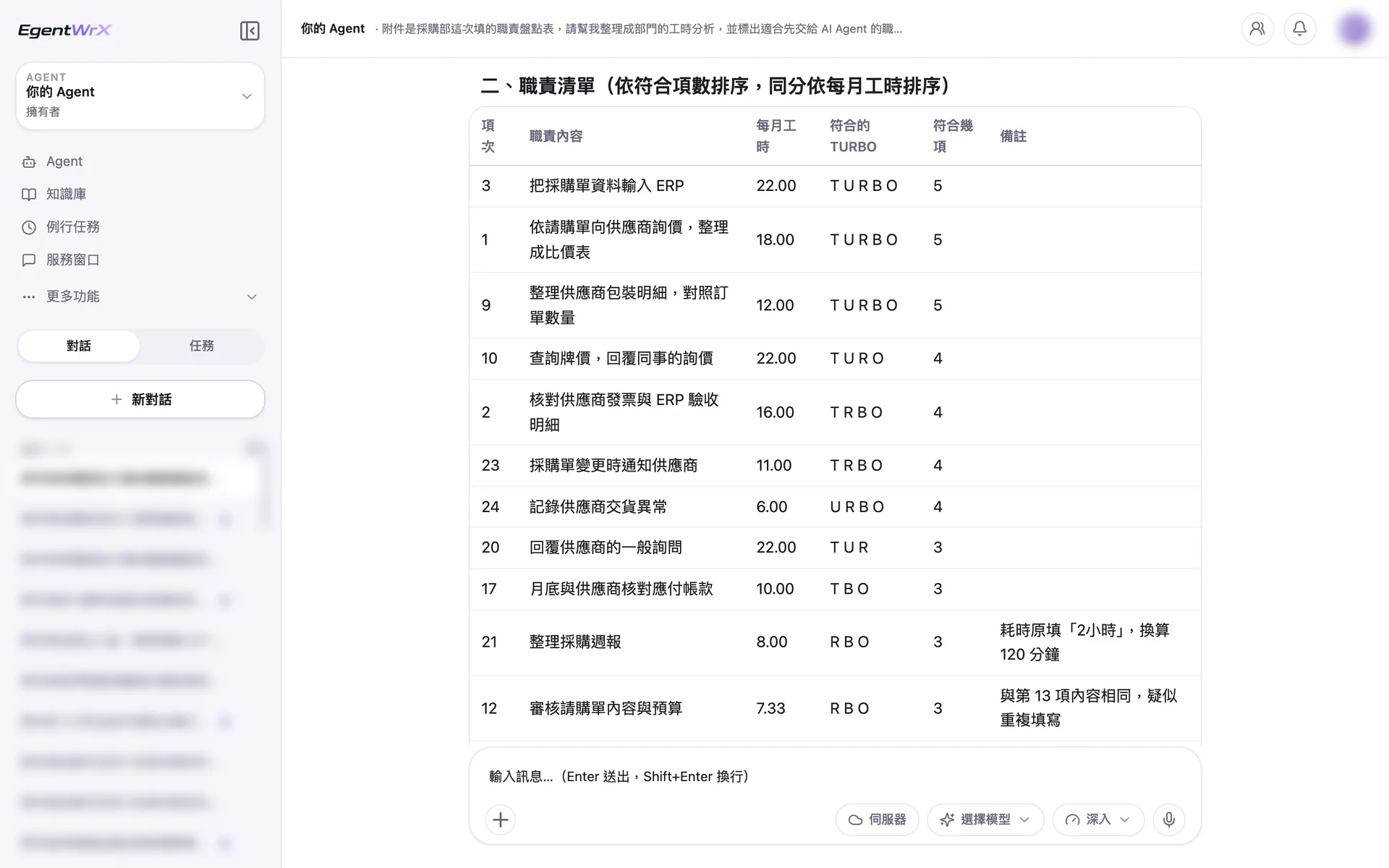
- 1The three responsibilities that meet all five criteria appear first and can be considered for the first tasks.
- 2Responding to supplier inquiries takes 22 hours per month, but no reviewer is available and the steps are unclear, so it meets only three criteria.
- 3Convert the entered duration of "2 hours" to 120 minutes.
- 4Two people entered the same task. Flag it as a possible duplicate, but do not merge the entries.
04Data Requiring Correction
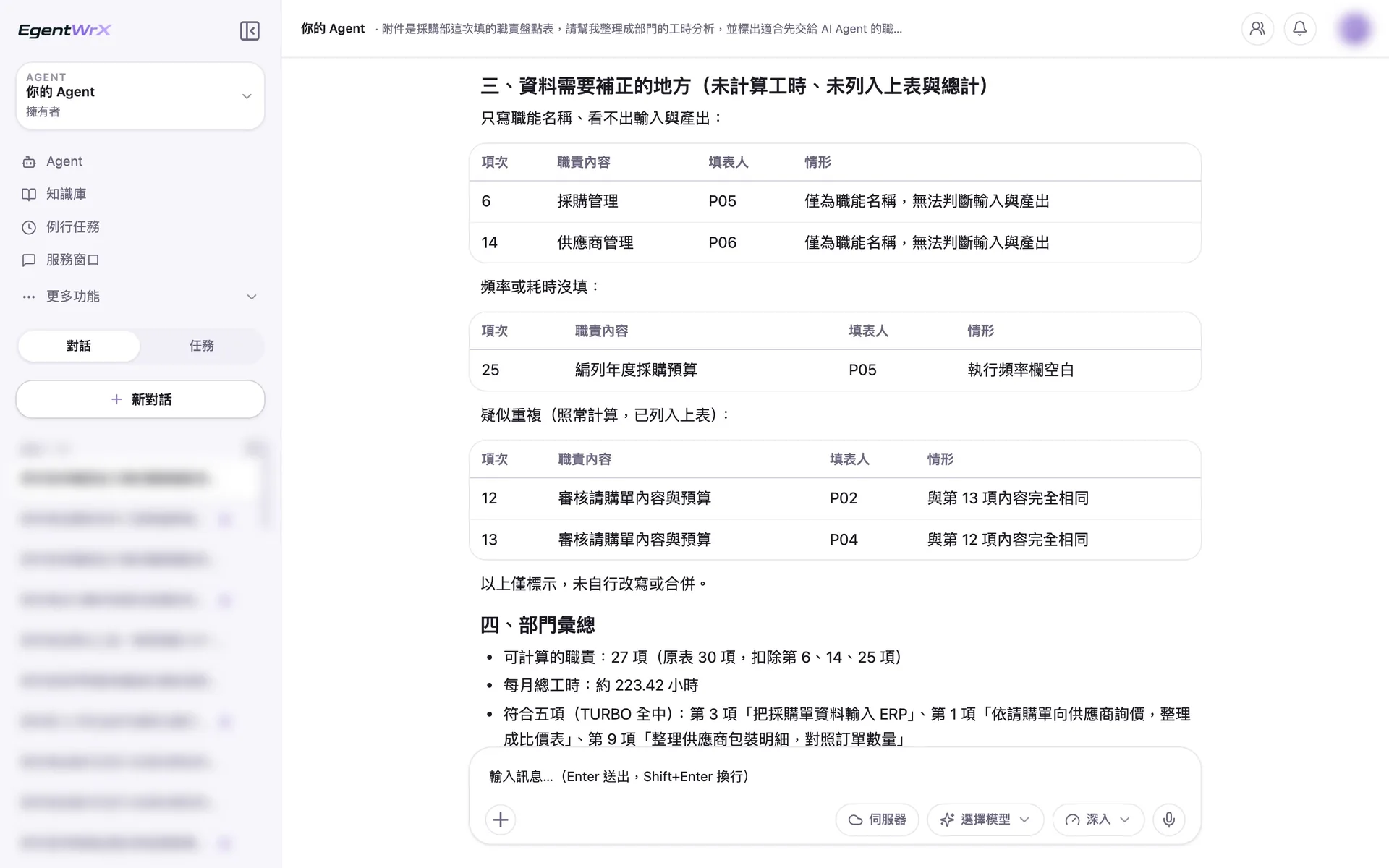
- 1Do not calculate work hours for the two entries that only name job functions. Ask the employees who completed the form to correct them.
- 2One entry omits the frequency, so its monthly work hours cannot be calculated.
- 3Calculate possible duplicates as usual and only flag them.
- 427 items can be calculated, totaling 223.42 hours per month.
This scenario has no client figures; the description above reflects typical practice.
FAQ
- Why not ask employees directly what they want AI to do?
- That approach requires employees to understand what AI can do and break their work down into tasks that can be assigned. Instead, ask what they do in their regular work. Everyone can start by listing tasks that occur daily, weekly, or monthly. Whether AI can perform those tasks can be determined in the next step.
- What if employees worry that reported work hours will be used for performance evaluations?
- Clearly explain the purpose and access permissions first. Use the inventory only to estimate task value and establish a baseline, not to rank individuals. Only department managers and the implementation team can access the raw data. Management meetings review department totals only. If the time required is difficult to estimate, start by recording frequency and steps.
- What should we do after the inventory is complete and the first tasks are live?
- Ask department managers and the implementation team to review implementation progress together. Confirm that the first tasks are operating reliably, have assigned maintainers, and have people responsible for handling exceptions. Then select the next tasks from the same inventory list. This allows each expansion step to use the experience gained from the previous group of tasks.
Where to go next
Want every employee to have their own AI teammate?
A consultant will be in touch shortly.