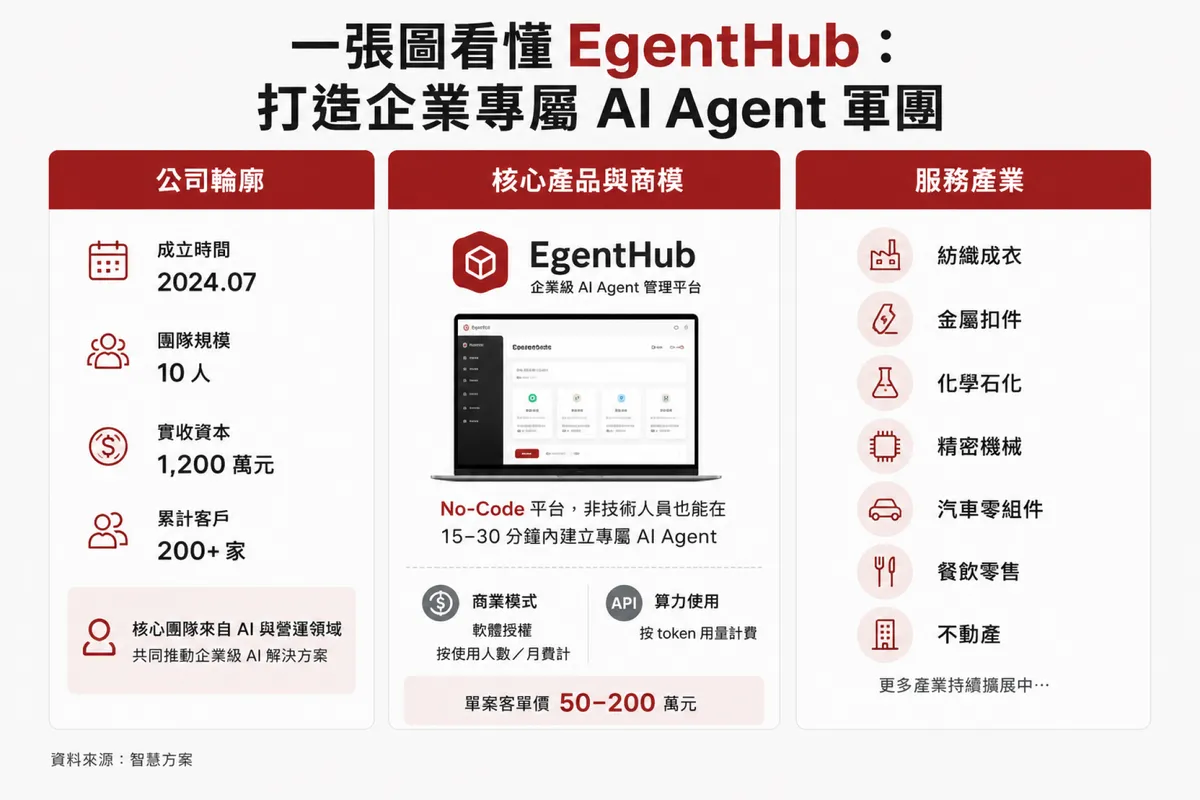
Last month, a reporter from Business Next approached us to understand one thing: Intellicon Solutions has only 10 full-time employees, so how can we serve more than 200 manufacturing clients at the same time—and turn a profit from our very first year? It sounds like a compelling story, but behind it are two more important questions: How can a small team support so many large clients? And why are enterprises willing to pay for it? The answer has little to do with AI tools themselves. It has much more to do with the capabilities required for the next generation of work—and that is what we are really selling.
Part One: How 10 People Deliver the Impact of 50
Intellicon Solutions was founded in July 2024 as founder Albert Chen’s second venture. His first was AboveNet Technology, established 26 years ago. This time, he deliberately took the opposite approach: a modest angel round, strict spending controls, and expansion funded entirely through cash flow. Even our proposals, technical documentation, and client training materials are handled by AI Agent.
Our leverage model has two layers. At the first layer, one employee directs 10 Agents simultaneously. At the second, each Agent calls on external resources as it executes—connecting to a client’s ERP system, retrieving data from search engines, or running translation models. With these two layers combined, a single person can have 50 specialized workstreams operating behind them at once. That is the actual formula behind “10 people delivering the impact of 50.”
The textile industry offers a concrete example. Turning a sales order into production drawings that factory technicians can understand involves identifying primary and secondary materials, interpreting workmanship descriptions, and assessing patterns. In the past, this process depended entirely on the judgment and experience of senior employees; a new hire could take six months just to learn how to interpret an order. After breaking the workflow down with AI Agent, a task that once took three hours can now be completed in under 30 minutes. The same logic applies to quotation workflows in the electronics industry: receiving the request, forwarding it to engineering, breaking down the specifications, checking the bill of materials, preparing the quotation, and responding to the client. A process that originally took two or three days can be divided among several Agents working in parallel, dramatically reducing turnaround time.
This model works because of EgentWrX’s product design: non-technical users can build their own dedicated AI Agent in 15 to 30 minutes without involving an engineer. By lowering the barrier to entry, one person can genuinely direct 10 Agents without becoming overwhelmed by Agent maintenance and operations.
Albert Chen also frequently reminds the team that managing Agents is different from managing people. People will try to interpret intent on their own. Agents—at least for now—execute instructions literally. You need to know how to break down tasks, write clear instructions, and validate the results. At a more advanced level, you must be able to orchestrate multiple Agents at once, review the output of each one, and turn an execution error into a standardized success criterion for the next run. This is more than an internal discipline for our team. We believe it will become a fundamental workplace capability for the next generation. That brings us directly to the second part of the story: we have turned this discipline into a methodology that we teach our clients.
Part Two: FDE—Turning the Ability to Direct Agents into a Methodology
FDE stands for Forward-Deployed Engineer: a consulting role embedded at the client site that combines industry expertise with hands-on AI Agent capabilities. More than half of our team serves in this role, which was also a key competency highlighted in the original report.
A strong FDE has three essential capabilities. First, they can quickly turn a client’s vague needs into a clearly defined use case through conversation—typically within 30 minutes. Second, they can organize tacit knowledge scattered across emails and the minds of veteran employees into structured data. Third, they understand the differences among models and can select the right combination for each use case: Claude delivers consistent performance on long-form writing, GPT provides reliable tool calling, and Gemini excels at multimodal integration. All three capabilities are indispensable. Someone who understands only the industry cannot write executable Agent instructions, while someone who understands only the technology cannot identify where the client is truly getting stuck.
The value of an FDE is not in completing the work for clients, but in teaching clients how to direct Agents themselves. Internally, we use the TURBO framework to divide this process into three stages. In the awareness stage, we help the client’s team develop an accurate understanding of what AI Agent can and cannot do. In the seed-team development stage, we select a small group of initial users to gain hands-on experience and build the first set of usable Agents. In the organizational integration stage, we replicate the methodology across other departments, making it routine for one person to direct an entire workforce of Agents within the client organization.
Once this methodology has been taught, it begins to spread on its own. After employees in sales, engineering, human resources, and procurement learn how to direct Agents, they pass the capability on to their own teams. In this way, our consultants’ expertise is replicated throughout one client organization, then across that client’s supply chain, one layer at a time.
Why Enterprises Are Willing to Invest
The gap in AI capabilities across industries is becoming a visible gap in efficiency. We can already see this clearly among the more than 200 clients we serve. We believe that over the next two to three years, this gap will increasingly determine each company’s competitive position within its industry. Companies that were not previously in the same market may even gain early proficiency with AI Agent and move into your existing customer base. These are changes we witness firsthand at client sites every day.
This is also why many business leaders approach us proactively. They want their employees to learn how to use AI Agent independently and create greater impact within their respective areas of expertise. As competition intensifies, their companies will still have a group of AI-proficient professionals with real-world experience who can continue creating value. In other words, learning how to harness AI—or how to become an effective manager of AI Agent—is what we are truly teaching our clients.
By combining this methodology with an AI Agent platform, textile companies have reduced three-hour order-interpretation tasks to under 30 minutes, while electronics companies have dramatically shortened quotation processes that once took two or three days. Every client that adopts the methodology is replicating these capabilities across its workforce and, in some cases, throughout its supply chain.
Once employees learn to structure their work and formalize it into repeatable processes, they can combine that foundation with an AI Agent platform and delegate execution to AI. Reading emails, querying databases, writing analytical reports, identifying sales opportunities, reviewing CAD drawings, and generating internal production orders from specification sheets can all fall within an Agent’s scope of work. After completing a task, the Agent can pass the results directly to the next employee’s Agent, allowing the entire cross-functional workflow to continue without waiting for someone to transfer the work manually.
This allows enterprises not only to achieve what we have—enabling each professional to deliver three to five times the output—but also to close internal gaps in AI capabilities. The output of every department can be handed off to the next department’s Agent, eliminating dependence on a small number of employees who know how to use AI. This is the role Intellicon Solutions has chosen to play: we are not selling AI; we are teaching you how to use AI yourself.
FAQ
Why doesn’t Intellicon Solutions take this opportunity to expand its workforce?
It is not that we cannot; we simply choose not to. Albert Chen places greater value on refining and fully developing the methodology of “one person directing an Agent workforce” and replicating it across more clients, rather than increasing the size of the company.
How is an FDE different from a typical AI consultant?
Traditional implementation consultants usually understand either the technology or the industry. An FDE must understand both, while also being able to operate Agents personally and validate their output. The role is closer to “an industry consultant who can code” than to a conventional trainer.
What should an enterprise do first to learn this methodology?
There is no need to begin with large-scale systems integration. It is more effective to start with a small group of seed users and develop several replicable Agents than to require the entire organization to adopt the technology at once. This is precisely the purpose of the “seed-team development” stage in the TURBO framework.
Is there a significant difference between adopting AI Agent now and waiting another two years?
We believe the gap will continue to widen. Employees at companies that have already adopted AI Agent are accumulating practical experience in working alongside it. That experience is difficult to acquire quickly. The longer an organization waits to begin, the larger the gap it will need to close.